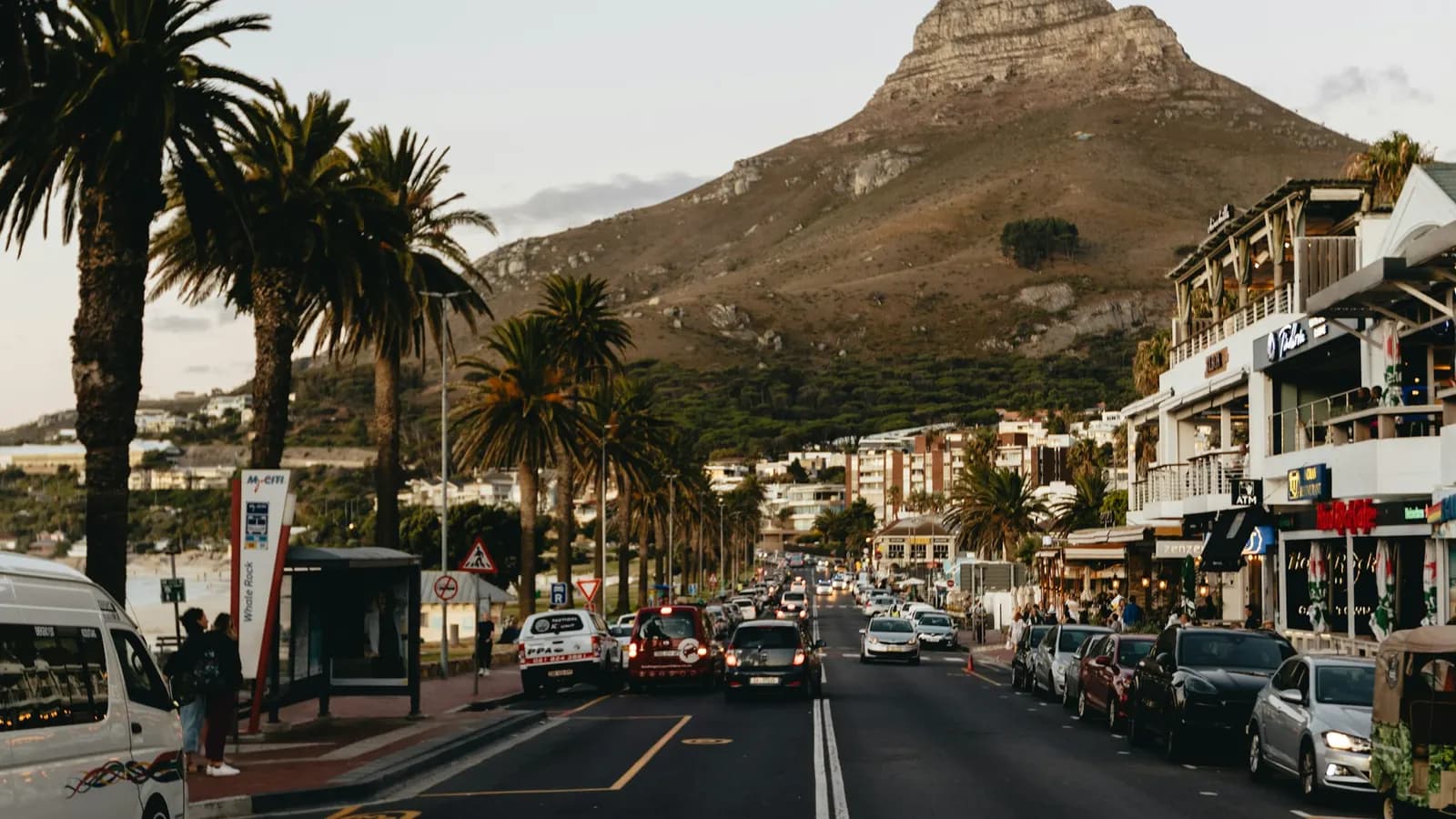
Driving in Cape Town is easier than most visitors expect: good roads, English signage and a compact city where the mountain is always there to orient you. But South Africa has its own rules and habits — four-way stops, minibus taxis, petrol attendants, "robots" — and a few of them can trip up even experienced drivers. This is our local's guide to the rules of the road, the slang, speed limits and cameras, alcohol limits, peak traffic, fuel and tolls.
The road rules that matter most
- Keep left, pass right. South Africa drives on the left. On multi-lane roads, keep to the left lane unless overtaking.
- Seatbelts for everyone, front and back. Children must be in an appropriate child seat — we supply infant capsules, child seats and boosters.
- Hands-free only. Holding a phone while driving is illegal. Use a phone mount, Apple CarPlay or Android Auto.
- Give way to the right at circles (roundabouts), and drive around them clockwise.
- Headlights in poor visibility. Many locals drive with headlights on all day — it's a good habit on the open road.
- Carry your licence (and IDP if you need one) at all times when driving. Traffic officers run regular roadblocks.
Visitors often ask about the yellow line. On single-lane highways, slower vehicles often move partially onto the paved shoulder to let faster traffic pass, and drivers flash their hazard lights as a thank-you. It's a deeply ingrained courtesy, but only do it where the shoulder is clear and you can see well ahead — and never pull onto it on a blind bend.
South African road slang
| Local term | Meaning |
|---|---|
| Robot | Traffic light |
| Circle / traffic circle | Roundabout |
| Yield | Give way |
| Bakkie | Pick-up truck |
| Taxi | Usually a minibus taxi — shared public transport, not a metered cab |
| Garage | Petrol (gas) station |
| Petrol attendant | The person who fills your tank for you |
| Car guard | Informal parking attendant, tipped on departure |
| Pavement | Sidewalk |
| Just now / now now | Some time soon / very soon — don't set your watch by either |
Watch out for minibus taxis. They're the backbone of local transport and stop frequently, sometimes without warning, to pick up passengers. Leave a generous following distance and don't be surprised by sudden lane changes.
Four-way stops
Four-way stops — marked with a STOP sign and a small "4-way" plate — are everywhere in Cape Town's suburbs. The rule is simple: every vehicle must stop completely, and whoever stopped first goes first. If two cars arrive at the same time, the car on the right generally goes first; in practice, a wave settles it.
Rolling through a stop sign is one of the most common traffic offences for visitors — officers do watch for it.
Speed limits and cameras
| Road type | Limit |
|---|---|
| Urban areas (built-up) | 60 km/h |
| Rural roads outside urban areas | 100 km/h |
| Freeways (e.g. N1, N2 outside the city) | 120 km/h |
Signposted limits override these defaults — you'll see lower limits on parts of the city's urban freeways, around schools and on mountain passes. Cape Town uses fixed cameras, mobile camera vans and average-speed (point-to-point) sections on some Western Cape highways, so slowing down only at the camera doesn't help.
Traffic fines are linked to the car's registration and sent to us; we pass them to the renter with a R250 administration fee, so it pays to stick to the limit.
Alcohol limits
The legal limit for drivers is a blood-alcohol concentration of 0.05 g per 100 ml (a breath-alcohol reading of 0.24 mg per 1,000 ml). For professional drivers it's 0.02 g per 100 ml. That's low: for many people, a single glass of wine can be enough to approach it.
- Roadblocks with breathalysers are common, especially on weekends, at month-end and over the festive season.
- Drunk driving is a criminal offence in South Africa — not a fine. It can mean arrest and a night in a cell.
- Rental cover doesn't apply if the driver is over the limit.
Planning a wine-tasting day? Nominate a designated driver or book a chauffeur in Cape Town — our Cape Winelands day-trip guide compares the options.
Peak traffic times
Cape Town's rush hours are short but intense, because most commuter traffic funnels along a handful of routes into the City Bowl.
| Period | Worst routes |
|---|---|
| Morning, ≈ 06:30–09:00 | N1 and N2 inbound, M5, M3 towards town, Koeberg Road |
| Afternoon, ≈ 15:30–18:30 | N1 and N2 outbound, M3 towards the Southern Suburbs, Victoria Road at sunset in summer |
| Airport | N2 inbound in the morning peak; allow extra time for afternoon flights on Fridays |
School holidays noticeably lighten the commute. Summer weekends bring their own jams on the Atlantic Seaboard and towards the beaches.
Fuel: attendants, tipping and monthly price changes
South African petrol stations are full-service. Pull up, tell the attendant what you need ("fill it up with 95, please" — or diesel, if that's what your car takes), and they'll pump the fuel. They'll often offer to check the oil, water and tyre pressure and clean the windscreen. A small tip is customary, more if they've done the extras.
- Check the fuel type on the fuel cap or your rental agreement. Our Fortuner, X5, Range Rover, Hilux, V-Class and Quantum are diesel; most others take 95 unleaded.
- Petrol prices are regulated and change on the first Wednesday of each month, so every station in the same zone charges the same price for petrol. Diesel has a regulated maximum, so it can vary slightly.
- As at October 2026, 95 unleaded at the coast costs roughly R29 per litre, after a large monthly increase. Diesel prices differ.
- Most stations take cards. Many are open 24 hours on main routes.
Tolls
There are no e-tolls in the Western Cape — no overhead gantries or accounts to worry about. You'll only meet conventional toll plazas, paid by cash or card:
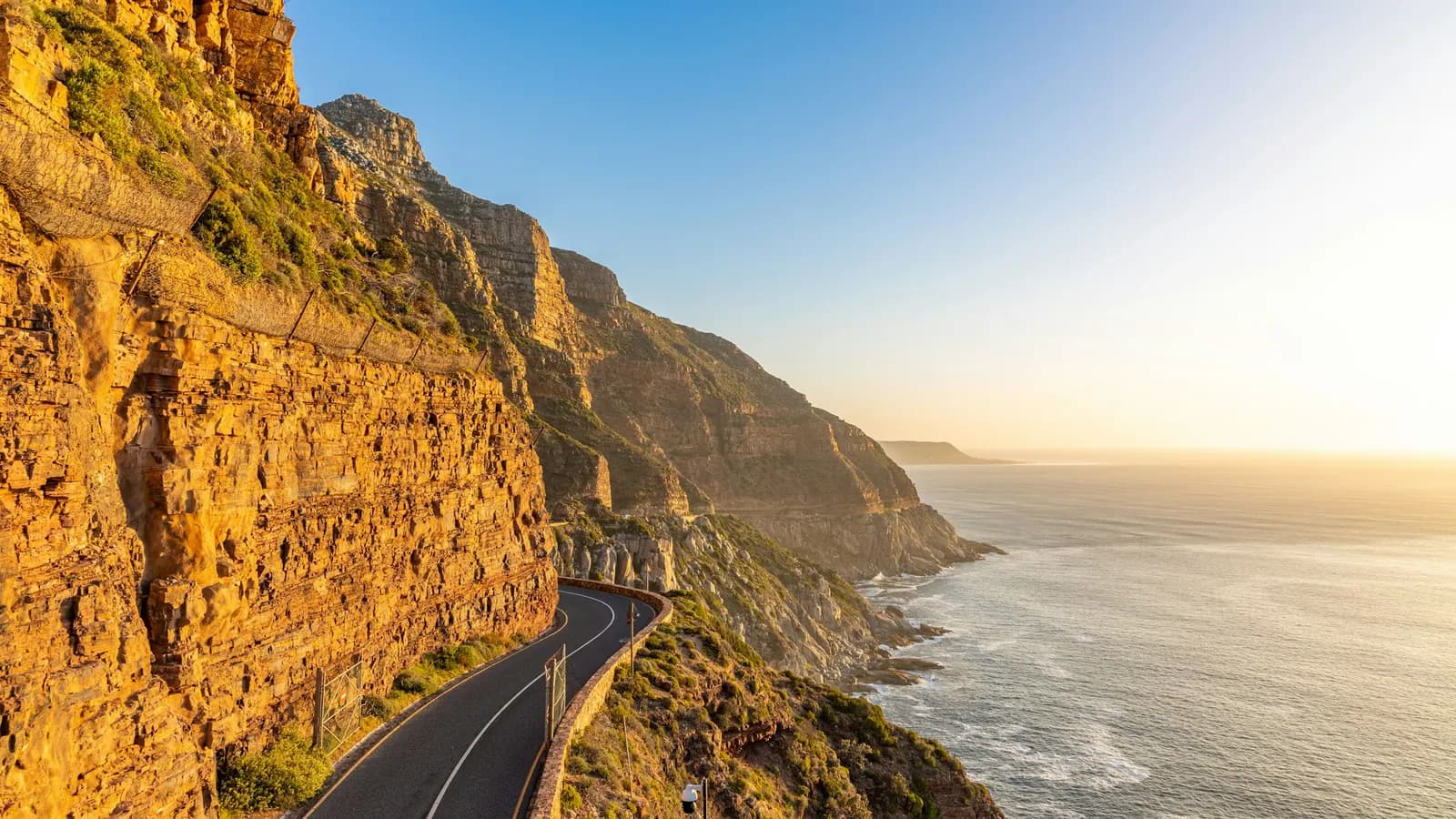
- Chapman's Peak Drive — about R68 per trip for a car, as at October 2026. See our Chapman's Peak guide.
- Huguenot Tunnel on the N1 between Paarl and Worcester, if you're heading inland or onto Route 62.
- Tsitsikamma on the N2, if you drive the far end of the Garden Route.
Ready to drive? New visitors should also read renting a car in South Africa as a foreigner and our is it safe to drive in Cape Town? guide, then choose your car from our Cape Town car hire range.
Mylz Rentals
Plan your trip
Meet & greet at Cape Town International, or delivery and collection across Cape Town and the Winelands. No rental desk, no queue.
Frequently asked questions
What is driving like in Cape Town?
Relaxed outside rush hour. Roads are good, signs are in English and the city is compact. The main adjustments are driving on the left, four-way stops, minibus taxis that stop suddenly, and short but heavy morning and evening peaks.
What is the alcohol limit for driving in South Africa?
0.05 g per 100 ml of blood, or 0.24 mg per 1,000 ml of breath. Professional drivers have a lower limit of 0.02 g per 100 ml. Drunk driving is a criminal offence, so the safest rule is not to drink at all if you're driving.
When does traffic start in Cape Town?
On weekdays, inbound traffic builds from about 06:30 and eases after 09:00. The evening peak runs from roughly 15:30 to 18:30 on outbound routes. Fridays and the start of school holidays are busiest.
Are there e-tolls in Cape Town?
No. The Western Cape has no e-tolls. Conventional toll plazas operate on Chapman's Peak Drive, the Huguenot Tunnel on the N1 and the Tsitsikamma section of the N2.